Showing posts with label growingpost. Show all posts

Friday, March 21, 2008

Robby's Pythagoras Growing Post

Part 1:
What is a Pythagorean Triple?
-A Pythagorean Triple is 2 square numbers that when added together, equal another square number. The equation for one is:
a
² + b² = c²

There are many Pythagorean Triples, but often are confusing to find because when you look at a number squared, like 5
², you often ignore or don't see the little ² and end up multiplying by 2 instead of multiplying by 5 again, which is what you should have done. This mistake makes a big difference. 10 is a smaller than 25, and everybody knows that specific math questions have to have an exact answer. A number squared simply means that number times itself. The opposite of squaring is square rooting, which is finding what number times itself equals the larger number.

Anyway, here is my perfect square chart. The highlighted numbers or the ones that are the same color is 1 Pythagorean Triple.


Part 2:

Part 3:

Word Problems:

When reading math related word problems, underline important parts and circle the key numbers. Cross out unnecessary or unimportant information, if there is some:


A pictorial version of this problem would be:


The sides are 90 units because, since the measurements of the sides weren't given, you have to go to common sense for help. A square is 360 degrees, meaning it has 4 right angles (90 x 4 = 360). A triangle is half of a square, so it has 180 degrees (90 x 2 = 180) in angle. But we aren't finding the angle of the sides, but the length. So the degrees sign (°) is replaced with units (or u) in place of a measurement.
The new picture of the problem looks like this:


Now we can simply do the equation a² + b² = c² to solve this:
a² + b² = c²
90²+ 90²= c²
8100+8100=c²
16 200=c²

√16 200 = √c²


127.27= c

So the missing hypotenuse is 127.27 units in length. You have to throw the ball 127.27 units from first base to third base to get throw the runner out.

Part 4:
Create your own problem:

You are racing down the street on your new 10 speed bike. You see a ramp that 2 of your friend are hauling, and you must jump it to prove you aren't a noob. But your stupid friends are hauling it way further than they are supposed to, 3 meters left of you instead of being straight ahead of you. You are 10 meters away now and must swerve to jump the ramp and end up having to jump at an angle. How many meters do you have to swerve to get to that ramp?

Now, with the key parts highlighted:


Now to answer the question:
What we know:
a = 3 meters
b = 10 meters
c = ?

Here's a little doodle I made on how the problem would look.


Now that we have the numbers, we just do the equations and solve it.
a² + b
² = c²
3
² + 10² = c²
9
+ 100 = c²
109 = c
²

√109 = √c²
10 9/21 = c

10 9/11 = 10.42
c = 10.42
c²= 109

So, after solving what the missing side was, you now know that you must swerve 10.42 (closest to 10) meters to the left to jump the ramp. Once you do that, and don't break your neighbors car from jumping onto it, you can retire from your career of dare-deviling and get a nice job as a professional lawn mower.

The End (of Part 4 )

Sunday, March 16, 2008

Kenneth's Pythagoras Growing Post

Describe what a Pythagorean Triple is and use your perfect square chart from 1 squared to 10 squared to find another one other than 3,4,5. (Note: You need a picture, not simply text.)
The Pythagorean Triple is a triangle that has 3 sides to it with a right angle. The small sides of the triangle are labeled (a and b) legs. The longer side is (c) or the hypotenuse, when you add the squared legs together it will add up to the hypotenuse. In other words as + bs = cs, when you put numbers to replace the letters you will get 3s + 4s = 5s = 9 + 15 = 25. ( the s stands for squared )


Jonah's Pythagoras Growing Post

Part 1:
Describe what a Pythagorean Triple is and use your perfect square chart from 1 squared to 10 squared to find another one other than 3,4,5.
This a PERFECT SQUARE CHART it will help you to find a Pythagorean Triple:
In a right angle triangle, there are 3 sides. They are A and B (which are legs) and C (which is a hypotenuse). The Pythagorean Theorem states that a + b = c. ( Leg + Leg =Hypotenuse).
Part 2:
Using embeddable web 2.0, describe how to find the missing side of a Right Triangle using the Pythagorean Theorem, show how to solve both for a missing leg and the hypotenuse.


Part 3:
Explain how to solve a Pythagoras word problem. Use one of the examples we covered in class (Worksheet A, B, LeFrog or Bonus Problem).
First we circle all the numbers in the problem and underline all the important facts. It help us since if we put it all together then it will make more sense, by just picking out what is important. Then we draw a diagram of the question with all the information we gathered in the right places.
Once we have drawn the diagram we can answer the question.

Part 4:
Now that you have seen many Pythagorean problems, create your own word problem.


Tasha's Pythagoras Growing Post

The Pythagorean Triple

Part 1:
Describe what a Pythagorean Triple is and use your perfect square chart from 1 squared to 10 squared to find another one other than 3,4,5. (Note: You need a picture, not simply text.)

-This perfect square chart can help you find the Pythagorean triple

A Pythagorean Triple is made up of perfect squares, another Pythagorean triple besides 3,4,and 5 is 6,8, and 10. Six squared is 36 Plus 64 from 8 squared equals 100 which is the square root of 10.


Part 2:Using embeddable web 2.0, describe how to find the missing side of a Right Triangle using the Pythagorean Theorem, show how to solve both for a missing leg and the hypotenuse (note: you may use numerical examples ex. a=4 b=6 c=?)

Find the Missing Leg


BubbleShare: Share photos - Powered by BubbleShare

Find the Missing Hypotenuse

BubbleShare: Share photos - Powered by BubbleShare

Part 3:Explain how to solve a Pythagoras word problem. Use one of the examples we covered in class (Worksheet A, B, Le Frog or Bonus Problem).

Le Frog stands 1.5 m from the wall where a fly is 2 m high. If the frogs tongue comes out of his mouth 70 cm from the ground, how far does his tongue have to stretch to trap and eat the fly?


Part 4:Now that you have seen many Pythagorean problems, create your own word problem.

Bob is at Best Buy, and is looking to buy a new flat screen t.v, but he didn't bring the measurements for his t.v stand, so he has to do some math thinking to see if his new t.v will fit. He knows that the TV screen is 15 inches long. If the diagonal measures 20 inches, how long is the width of Bob's TV?


Romulo's Pythagoras Growing Post


PYTHAGORAS GROWING POST


The Pythagorean Triple


A Pythagorean Triple states that the sum of the squares of the legs (a and b) of a right angle triangle equals the square of the hypotenuse(c). The hypotenuse is the side opposite of the right angle and is the longest side of the triangle. So the triple is basically a2(squared) + b2(squared)= c2(squared). Any numbers can be placed in as a, b or c as long as when it's used the equation is correct and it works. The a, b and c most of the time have to be lowercase. The legs a and b are interchangeable when labelled and either leg can be labelled a or b. If you don't understand what I'm trying to say, the picture below explains what I'm trying to say.


Another Pythagorean Triple besides 3, 4 and 5 that's between 1 to 10 squared is 6, 8 and 10 which you get by multiplying 3, 4 and 5 by 2. It works because.....just look at the picture below.


Part 2


Part 3
See Scribe Post.


Part 4


You are trying to break into your rich neighbours house and you know the door has a anti-theft alarm. The only way in is an open window which is 4.5 feet above the ground. There's a big pool of mud 5 feet away from the house and you know you can jump it but you don't want to risk the chance of getting your new shoes dirty and don't want to go back home and change it because it'll take too much time. You have plenty of stolen ladders but don't know how long your ladder should be. How long should your ladder be to reach the window and not get your feet dirty. Round to the nearest ones place. Please click image if too small

Image Hosted by ImageShack.us


Saturday, March 15, 2008

Vicky's Pythagoras Growing Post

Part 1
Pythagorean Triple:

Describe what a Pythagorean Triple is and use your perfect square chart from 1 squared to 10 squared to find another one other than 3,4,5.

This is a perfect square chart from 1 squared to 10.


The Pythagorean Theorem states that the legs (a and b) and the hypotenuse (c) Also a squared must be the lowest number, and c must be the highest number. A right triangle obey the following relationship----> A2+B2=C2


Two other examples of Pythagorean Triple, using 6, 8, 10.


BubbleShare: Share photos - Play some Online Games.


Part 2
Describe how to find the missing side of a Right Triangle using the Pythagorean Theorem, show how to solve both for a missing leg and the hypotenuse

Missing Leg


This is what we know
a squared= ? squared
b squared= 32 squared
c squared= 40 squared

The formula is a + b = c
a + 32 squared = 40 squared
a + 1024 = 1600

To get a squared we need to subtract 32 squared (b) from 40 squared (c).

c-b=a
40 squared - 32 squared = a squared
1600 - 1024 = a
a = 576
576 = 24 squared

a squared= ? squared
b squared= 32 squared
c squared= 40 squared


Missing Hypotenuse


This is what we know
a squared = 96 squared
b squared = 128 squared
c squared = ? squared
Formula is a + b = c
96 squared + 128 squared = c squared
9216 + 16384 = c
c = 25600
25600 = 160 squared

a squared = 96 squared
b squared = 128 squared
c squared = 160 squared

Pythagorean Triple Chart
3 squared + 4 squared = 5 squared
6 squared + 8 squared = 10 squared
12 squared + 16 squared = 20 squared
24 squared + 32 squared = 40 squared
48 squared + 64 squared = 80 squared
96 squared + 128 squared = 160 squared
192 squared + 256 squared = 320 squared
384 squared + 512 squared = 640 squared


The pattern is to multiply each term by 2.


Other Pythagorean Triple Chart I have found online

( 3, 4, 5)
( 5, 12, 13)
( 7, 24, 25)
( 8, 15, 17)
( 9, 40, 41)
(11, 60, 61)
(12, 35, 37)
(13, 84, 85)
(16, 63, 65)
(20, 21, 29)
(28, 45, 53)
(33, 56, 65)
(36, 77, 85)
(39, 80, 89)
(48, 55, 73)
(65, 72, 97)

Part 3:Explain how to solve a Pythagoras word problem. Use one of the examples we covered in class (Worksheet A, B, LeFrog or Bonus Problem).


First circle all the important numbers, and underline all the important facts, to keep us organize.

Next draw a diagram of the question, and use the information that we've accumulated to label the appropriate areas.

Now use the pythagorean theorem to solve the missing side
The missing side is the hypotenuse.
What we know
a = 1.3m (0.7m - 2m)
b = 1.5m
c = ?m
Here is the pythagorean theorem
a squared + b squared = c squared
1.3m squared + 1.5 squared = c squared
1.69m + 2.25m = c squared
3.94m = c squared
3.94m square root = c squared square root
3.94m square root = c
1.98 = c (use a calculator, square root of 3.94)

a = 1.3m
b = 1.5m
c = 1.98m


Part 4: Now that you have seen many Pythagorean problems, create your own word problem.
Mizz Froggy stands 8.9 m from the wall where a fly is 8 m high. If the frogs tongue comes out of his mouth 10 cm from the ground, how far does his tongue have to stretch to trap and eat the fly?

Chantel's Pythagoras Growing Post

Part 1:
Pythagorean Triple:
The Pythagorean theorem states that the legs (a && b) and the hypotenuse (c) a right triangle obey the following relationship----> A2+B2=C2

Using the perfect square chart you can find Pythagorean Triples.

Number | Square

1- 1
2- 4
3- 9
4- 16
5- 25
6- 36
7- 49
8- 64
9- 81
10- 100


Photobucket


Other Pythagorean Triples:

(5 12 13)
(7 24 25)
(8 15 17)
(9 40 41)
(11 60 61)
(12 35 37)
(13 84 85)
(16 63 65)
(20 21 29)
(28 45 53)
(33 56 65)
(36 77 85)
(39 80 89)
(48 55 73)
(65 72 97 )

Part 2:
Find the missing Leg;;
BubbleShare: Share photos - Play some Online Games.


Find the missing hypotenuse;;
BubbleShare: Share photos - Powered by BubbleShare


Part 2:
Problem B

You've just picked up a ground ball at first base, and you see the other
teams player towards third base. How far do you have to throw the ball
to get it from first base to the third base and throw the runner out?

PICTURE TIME! :D This picture shows the baseball diamond and where we
have to throw the ball!


Photobucket

Math work time:
a2=90 (2)
b2= 90(2)
c2= ??
a2+b2=c2
90(2) + 90(2) = C2
8100+8100= c2
8100+8100=16200
16200= c2

\/c2= \/ 16200 ( \/= square root sign)

c2= 127.28


PART 4:

Word Porblem;;

The letter of the day was L. Everyone in the class had to draw a L on there page.
Majolanoire wanted to know how long is it from the bottom of the L to the top.
The knew that one side of the L was 4cm and the other side was 3 cm.
How is she going to figure out how long it is from the bottom of the L to the top.
help Majolanoire figure it out and explain it the best you can.


Photobucket

Vina's Pythagoras Growing Post


The Pythagorean Triple


When you add two perfect squares together (a square + b square) you get another perfect square (a square+b square=c square).
The legs or L shape of the right triangle is a and the hypotenuse is c.


Perfect Square Chart

In the perfect square chart 3 squared + 4 squared = 5 squared because... 3 squared in the perfect square chart is 9, 4 squared is 16 and 5 squared is 25. When you add 9 + 16 it equals to 25.
Another one is 6 squared - 36 + 8 squared-64 = 10 squared-100.


BubbleShare: Share photos - Powered by BubbleShare


Emily's Pythagoras Growing Post

Pythagorean Triple

Part 1.


The Pythagorean Theorem states that the two
legs (a & b) and the hypotenous is (c). The Pythagorean Theorem is - a2 + b2 = c2. The Pythagorean Triple is when you have 2 perfect squares you add the two perfect squares (the legs a & b) together. Then when you add them together you get another perfect square.


a2 + b2 = c2
(a squared + b squared = c squared)


The Perfect Square Chart


This picture shows what the number equals when it is squared, using this perfect square chart.


Part 2. Finding the missing side.


Finding the missing Hypotenuse.


Part 3. Le Frog problem.


Friday, March 14, 2008

Marina's Pythagoras Growing Post


Pythagorean Triple

Part 1:


The Pythagorean theorem states that the two legs are both ( a & b ) and the hypotenous is ( c ). The pythagorean triple is when you have three oerfect squares and you add two of the perfect squares ( the legs a & b ) together and then when you add them together you get another perfect square.


a squared + b squared = c squared !!


○ Perfect Square Chart


This shows what the number equals when its squared. using perfect squares !


BubbleShare: Share photos - Find great Clip Art Images.
Part 2: Find The Missing Side


Part 3: Le Frog
- Le Frog stands 1.5 m from the wall where a fly is 2 m high. If the frogs tongue comes out of his mouth 70 cm from the ground, how far does his tongue have to stretch to trap and eat the fly?


Part 4: My own math problem with " Pon & Zi "!


Then !?!....
I dont think i did it right though but my anwser was that the ladder needed to be 6.4 metres long so that pon could save zi...!
( maybe i should do another one but better ) ?!?

David's Pythagoras Growing Post

Part One:

The Pythagorean Triple!?!?
The pythagorean triple is when you have 2 perfect squares equal another perfect square, the formula for this is A squared + B squared = C squared.
A and B are the legs on the triangle like shown in the picture. A and B when added would = the hypotenuse which is C. The first perfect square is 3 squared + 4 squared = 5 squared, its true because 3 squared is 9, 4 squared is 16 and 5 squared is 25, 9 + 16 = 25!
Another pythagorean triple would be 6 squared + 8 squared = 10 squared because those are all perfect squares and 6 squared(36) + 8 squared(64) = 10 squared (100).


This picture probably explained things better than me.
Basically, a squared + b squared = c squared is the formula the triangle follows with a and b as the legs, and c as the hypotenuse. The pythagorean triple is just that and it uses perfect squares so theres no decimals or anything which makes it a lot easier.

Part Two:


Voicethread about finding the missing side. Enjoy!


Part Three:


The question I chose to solve, was the Bonus Question.

BONUS QUESTION

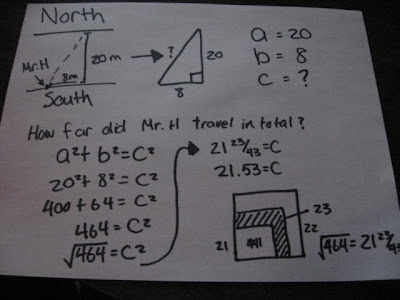
Mr. H. jumped into a canoe on the North bank of a river that is 20m wide. He crossed to the South side. When he got to the other side, he discovered that the current carried him 8 m West. How far did he travel in total?


So I took the information that I needed from the question, and drew a picture so I didn't have to think as much and have a pictorial representation of the question.


Then I listed the information that was given, a=20, b=8, and c=?. After that, I put in the theorem, a squared + b squared = c squared, then filled in what a and b were but left c blank because I don't know what it is yet. I then squared 20 and 8 and made them 400 and 64, then just added. I got 464 from that, and now I need to find the square root of it so I used the "mullet" strategy. With that i got 21 23/43 = c, and then made it into a decimal to the nearest hundredth. So Mr. H traveled 21.53m in total.


Part Four:


The Jump!

Your running down a road one day just having fun, when all of the sudden you get to a hole! The hole is 9 feet long, and you have to jump it because there are wild animals like savage rabbits and crazy pigs coming from behind you! Now the road on the other side of the hole is different, the road is 3 feet higher than the road your on right now with all of the animals coming at you. The hole is 19 feet down and it has a river running through down there and sharks and rocks and...other stuff. How many feet will you jump in total to get to safety on the other side of the road where there are people with big pointy sticks ready to hit something?