Today in class we learned about the circles and its radius, diametre, and circumferance. Later on during class we also learned how to find the area of a cylinder.
All about the radius and diameter : In class we were told that radius is the distance from the centre of the circle to the edge and you can get it by dividing the diameter because the diameter is double the distance of a radius going from one edge of the circle to the other. The formula to get the diameter : d=2r. meaning the diameter = 2x the radius.
The circumference :The circumference is the distance around a circle. You can get this by 2Pi r (2 x pi x r) pi 2r or pi x diameter.
Cylinder :In class we learned how to make a net of a cylinder. >PLEASE DO NOT DRAW A PEN15< also make sure that the circles are the same size.
L = Circumference W = Height
FORMULA A = Pi R2 C = Pi D A = 3.14 x 5cm2 C = 3.14 x ??cm A = 3.14 x ??cm C = 3.14 A = ??cm2
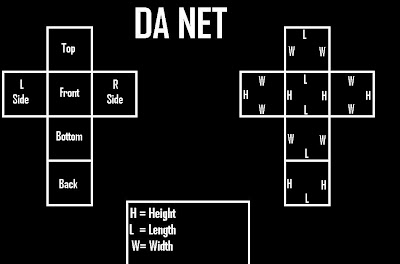
I have learned about length, width and height of a rectangular prism. I have also learned that you can open it up to make it flat. It is called a net! Each side still is the length, width, and height. l=length h=height w=width
To find the surface area you have to add up all the sides squared. If you had a 2x2x3 prism, you would have to multiply..
LxHx2 LxWx2 HxWx2
LxHx2 is the front and back of the prism. LxWx2 is the top and the bottom of the prism HxWx2 is the left side and right side of the prism.
After you add it up you should have the surface area. To find the Volume of a rectangular prism, you can just do Length x Width x Height! Volume is how many cubed (insert measurement here example cm) can fit inside the prism.
If the length = 2cm width = 2cm height = 3cm
You would do 2cm x 2cm x 3cm to get the volume The volume would be 12cm cubed.
What I know and learned about rectangular prisms: We learned about getting the Surface Area and Volume of rectangular prisms. But the step we always do is making a Net. Surface Area: There is a lot of work to do before you can actually find out the surface area. You have to find out the area of each of the shapes. The top, front, and the left side. You only need to find out only one of each shape because each one has a pair. The right and left sides, the front and back, and the top and bottom.
The formula for figuring out the top and bottom is LxW (length x width). Since you only need to find out one of each shape all you have to do is then multiply it by 2. So it would be lxwx2 to equal the answer with a exponent of 2 (squared). E.g 3cm x 2cm x 2 = 12 2 cm.
The formula for figuring out the sides is HxW (height x width). Again, since you only need to find out only one side all you have to do is multiply it by 2. So then it would be hxwx2 to equal the answer with an exponent of 2 (squared). E.g 6cm x 2cm x 2 = 24 2 cm. The formula for figuring out the area for the front and back is HxL (height x length). Since you only have to find out one of the shapes all you have to do is multiply the first answer by 2. So then it would be hxlx2 to equal the answer with an exponent of 2 (squared). E.g 6cm x 3cm x 2 = 36 2 cm.
Then you add all the numbers to together to get the total surface area. The exponent for surface area is always 2.
Volume: Figuring out the volume for a rectangular prism is some what harder that find the surface area. But in some ways it is easier because you are only figuring out what is the number of the inside of the shape. There are two formulas of finding the volume.
Area of the base x Width is one of the formulas. First you find out the measurement of the base. Then you multiply that by the width because that is how many base numbers you have. E.g Base number = 15 cm 2 and the width = 3 cm. So it would be 15 cm 2 x 3 cm= 45 cm 3.
The second formula is LxHxW (length x height x width). You first find out the measurement of the length, width, and the height. Once you do then you multiply them all together. E.g L = 5 cm H = 10 cm W= 3cm. 5cm x 10 cm x 3 cm = 150 cm 3.
In class we learned how to find the surface area/ volume/ & net of squares and rectangular prisms.
Net:
A net is a picture of a 3 dimensional object flattened out so you are able to view all sides n one dimension.
E.G:
The yellow shaded parts in the picture reps. the sides of the rectangle. The black shaded parts represent the top and bottom of the object and the blue shaded areas rep. the back and front. These colors also rep. that they are the same measurements. (e.g the yellow shaded areas are both 5 cm ) this will help you to find the surface area and volume later on.
Surface Area:
To find the surface area of a rectangular prism if you find the area of each side on the net all you would have to do is add up each side and get the surface area of a rectangular prism.
E.G:
( 8 + 8 + 12 + 12 +10 + 10= 60 cm (squared) )
Volume:
When finding the volume of a rectangular prism all you have to do is : [ Length X Width X Height ] measurements.
E.G:
As you can see all of these problems are easy to solve when you ahve a net and the measurements of the object.
A rectangular prism is a 3D(Three Dimensional)object that has sides called Height, Length, Width and it looks something like the picture below.
A rectangular prism has 6 faces and those faces are called Top, Bottom, Front, Back, Left Side and Right Side. We can see all 6 faces when we make a diagram called the Net. The Net is just a diagram showing what the rectangular prism would look like if you opened it up and flattened it out. The Net on the left shows all 6 faces and which ones they are and the Net on the right shows what each side is(Height,Length,Width). The Net helps you find the surface area of the prism.
What a Cube is
A cube is basically the same thing as a rectangular prism but the Height, Length and Width are all equal.
Just like the rectangular prism the cube also has 6 faces. The nets are also similar but the only difference is the sides in the cube are all equal. The net of the cube also helps you find the surface area.
How To Find The Surface Area of a Rectangular Prism/Cube
One way of finding the surface area is to divide them into groups and find their areas separately then add them all together. The groups you divide them into are Front/Back, Top/Bottom and Sides(L Side and R Side) because they are both equal and it makes life easier. There are different formulas for each group.
The formula for finding Front/Back is Area=2(Height X Length) or A=2(H X L)
The formula for finding Top/Bottom is Area= 2(Width X Length) or A=2 (W X L)
The formula for finding Sides is Area= 2(Width X Height) or A=2 (W X H)
The 2 is there because after you're done answereing the brackets you multiply what you got in the brackets by 2. After you find those you add them all up to get the surface area.
The other way to find surface area is to add all the sides up, but that way takes too long.
How To Find The Volume of a Rectangular Prism/Cube
To find the volume you can use the formula Length X Width X Height. The formula says it all so i don't think I need to explain it.
The other formula is Base X Height. The Base is usually either the Top or Bottom. This formula is also simple so I won't explain it.
Solving The Surface Area and the Volume of a Rectangular Prism/Cube
What I have learned/know about rectangular prisms.
Rectangular prisms are 3 dimensional shapes, and in class we've learned how to find certain things about the rectangular prism. First of all, theres something called the Net, which is just like what the prism would look like if you made it flat.
The next thing would be the measurements of the prism, if you look at the net, you can use that to figure out what the length, width, and height of the prism is. You could switch those numbers around though, because any side of the prism could be the bottom or the base because if you were going to cut it it would be the same on each side. So for our prism lets say we have a length of 8cm, width of 5cm, and a hieght of 2cm.
We can use those measurements now to figure out the surface area of the prism, so how many square cm are in that net. Its kind of broken up into pieces, but the face of the prism thats on the opposite side will always be the same if we're dealing with rectangles and...stuff. First we would want to figure out how large the top, bottom, left side, right side, front and back are. Height x Length is how you would get the front or the back, you would have to multiply your answer by 2 to get the area of both the front and the back. Height x Width is how you get the right/left sides, also multiple by 2 to get the area of both sides. Length x Width, this is how you would find the area for the top or bottom, again, multiply by 2 to get the area for both, if it was a square then all of the sides would be the same so if you found one out you know the rest. When we've figured out the are of each face on the rectangular prism, we need to add them up to get the surface area of the whole prism. We could add each little thing up, or we can do something like this, 2(hxl)+ 2(hxw)+ 2(lxw)=Surface Area
So with our rectangle, the surface area would be something like this:
2cm x 8cm = 16cm x2 = 32cm squared
2cm x 5cm = 10cm x2 = 20cm squared
8cm x 5cm = 40cm x2 = 80cm squared
32cm2 +20cm2 +80cm2= 132cm2
Thats only one way of doing this, and its pretty simple too because we found the area for all the sides before we added them up.
We also learned how to find the volume!
There are two ways we could figure out the volume, one was multiply all of the measurments of a rectangular prism. By that I mean Length x Width x Height, not the cm squared but how many cm it was on the side of the rectangular prism. If the prism had a 8cm length, 5cm width, and a 2cm height, then we could do 8cm x 5cm x 2cm = 80cm cubed (we use a little 3 to represent cubed and we use it to know we're talking about something in 3 dimensions).
You could do the same thing with a cube except you would have different numbers for the length, width, and height. Another thing we could do is Base x Height, your base is usualy the width x length. This solution is a little different though, you can represent it in a different way. But you would find out what the base is first, so usuing the cube again, it would have a base of 40cm squared, multiplying that by the height (2cm) would get us our volume of 80cm cubed. It would look something like this if you wanted to draw it out.
1st: find the area of the top and the area of the bottom. LxW. 2nd: find the area of the front and back. HxL= 3rd: find the area of the left side and right side. HxW=
 L = Circumference