Tuesday, May 6, 2008

Jordan's Scribe Post


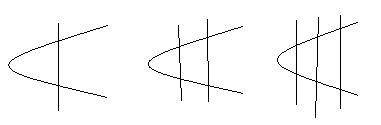
First, we started with 3 patterns:Then we had to find the next 2 patterns, which were:
Then we had to make a T-Chart for the patterns we found...
the numbers in the "y" row start at 1 and go up by 2 each time..
the numbers in the "x" row start at 0 and go up by 1 each time..
to get "y," you have to multiply "x" by 2, then add 1
Algebraic expression: y = 2n+1
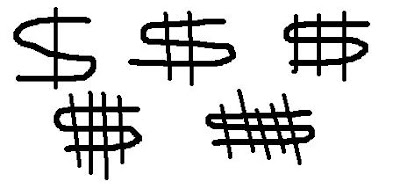
We started off with 3 different patterns this time... The 5 pictures looked like this:
(btw, the vertical lines through the strings are the cuts)
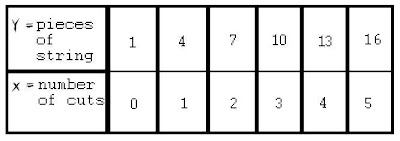
Followed by the T-Chart:
We found that the "y" row started @ 1 then increased by 3 each time
We found that the "x" row started @ 0 then increased by 1 each time
You have to multiply "x" by 3 then add 1 to get "y"
Algebraic Expression: y = (3n)+1
THE END.


Monday, May 5, 2008

Marina's 2nd Scribe Post

My Scribe

Okay today in class, I volunteered to do a scribe post. I made a little slideshow on voicethread, i dont really know if i did it right so yeah...
P.s. I did this all on piant,so it ,might be messy.. didnt take me very long.


-marina☺☻○

Robby's Scribe

Collecting Like Terms
Like terms are Terms that have the same Variables next to them. Variables are letters that stand for unknown or given numbers. Like terms are 2 or more terms that can be combined to simplify the equation. Lets look at an example:


This right now is an algebraic math sentence. In algebra, you don't always have to find an answer to the question, that is, if you aren't told what the variable stands for. This is one of those occasions.
In algebra, you don't use all the operators you would use for non-algebraic equations. Like, for example, times (x). Because times has a operator that looks like a variable, it gets confusing (Like so: Variable x X x = x ...no it's not what you were thinking). So they removed it (they being those math geniuses that invented algebra). Instead of writing 5 x (x+2), you remove the x and assume its multiplication. And when multiplying a number with a variable, you write them next to each other (5x). This becomes a Term.

Back to the math sentence in blue above. An easy way when multiplying things in brackets and theres a variable in there is to multiply the outside number with the variable. So it would look something like this:


Like I said before, when multiplying a number with a variable, you put the variable on the right side of the number and it becomes a term. So 5x means Five groups of variable x.

The next part of the question is the +2. You would read this as positive two, because in algebra, you deal with integer numbers a lot. Now you have to multiply it with 5 now, because its still in the brackets, and if there's no operator between the brackets and number on the outside, you assume its multiplication.


Now, we multiply the 5 with the 2. 5 x 2 = 10 (note, I used the x symbol for multiplying because we aren't multiplying the terms, and this equation won't go in the final answer, only the 10 will)
The math sentence now looks like this:


This is a proper algebraic sentence. The terms should always be on the left side, and the non-terms, or integers, on the right. Now to to show you how to write this question using algebra tiles. But first, look at the different kind of shapes used to represent the parts of a algebraic-math sentence.


Now that we know what shapes I'll be using mean, on with the algebra-sentence. I'll simply show what the simplified answer to the algebra sentence near the middle of my scribe-post looks like with algebra tiles...


=

Friday, May 2, 2008

David's Scribepost

Algebra Tiles

Algebra tiles are ways of showing algebra. The big sqares are the variable (n, x) squared, the long rectangles are the variable, and the little squares are the integer or the constant, it's just the number. There are two sides to Algebra Tiles, a white side, and a colored side, the white side means its a positive number, the colored side means its a negative number. So if your question is 3n+6 and you wanted to draw it out using Algebra Tiles, then it would look like this...

Theres something else that comes into effect when we do this, and its Zero Pairs. Zero pairs are when you have a positive and a negative, and they cancel eachother out.

It's like you owe money if there's a negative, and the positvive is how much money you have. Thats just one good way to try and understand intergers.

Afrer that we just did a bunch of questions and figured them out using algebra tiles, one of them would be 2n-6+4n-2+6-n. So how would you draw that out? Now if you can't tell where to start and which sign belongs to what, then try making the catapiller, start at the first number / opperation and circle to the next one.


Now thats nice but we want to group them.


We can get rid of some by finding zero pairs!


and we're left with 5n-2

And thats how you use Algebra tiles. We had homework too, 3 pages of it.

^ ^ On this one you only need to do up to question 18...^^

Good luck finnishing! I'm sure there's going to be more work.

Thursday, May 1, 2008

Nathaniel's Scribe Post

Patterns 2!!

Mr. Jerema gave us two charts the other day. We had to make a chart and a ratio table, describe the patterns in each row, describe the relationship between the two columns, make an algebraic equation to show that relationship, then find out what the 20th, 35th, and 99th diagram would be.

This is the first chart he gave us.


We had to make that into a chart.. like so


and into a ratio table..


3. Describe the patterns found in each row.
Well you can see that x, starts at 1 and goes up by 1, and y, starts at 1 and goes up by 2.

4. Describe the relationship between the two columns.
If you have the years over 10, and lets say you have 2. You would have to multiply it by two and subtract one to get y, since this works for all the years over 10.

C. Write and algebraic equation to show this relationship.
y=2x-1 x = years over 10

5. Predict what the 20th, 35th, and 99th diagram will look like.
We use the algebraic expression here, and having 20, 35, and 99 the years over 10.

note:re write the expression and fill it in.

20th
- 2x-1
- 2(20)-1
- 39

35th
- 2x-1
- 2(35)-1
- 69

99th
- 2x-1
- 2(99)-1
- 197

Now back to number one since instead of drawing the next two patterns, he said to find out the number of repairs for 7 and 8 years over 10.

7th
- 2x-1
- 2(7)-1
- 13

8th
- 2x-1
- 2(8)-1
- 15

And were done the car repairs! Onto Harbecks Training.


Then we had to make a chart, and a ratio table out of it..


3. Describe the pattern found in each row.
As you can see, x starts at one and increases by one each time, and y starts at 3, then adds 5, 7, 9 and adding so on by odd numbers.

4. Describe the relationship between the two columns.
If you have the number of weeks, to get the number of km's ran in total, you would have to multiply the number of weeks by itself, and subtract one to get the number of km's ran in total.

c. Write an algebraic equation to show this relationship.
y=x squared - 1 x=number of weeks

5. Predict what the 20th, 35th, and 99th diagram will look like.

20th
- xsquared-1
- 20squared-1
- 399

35th
- xsquared-1
- 35squared-1
- 1225

99th
- xsquared-1
- 99squared-1
- 9801

Then back to number one to find out what the 7th and 8th diagram will look like.

7th
- xsquared-1
- 7squared-1
- 48

8th
- xsquared-1
- 8squared-1
- 63

and your done!

Angel's Scribe

Algebra Test #1
For the first part of the test we had to write the following expressions in words..
  1. 3x+8 : Three times a number and eight
  2. 7x+5x : Seven times a number and five times a number
  3. 5(x+8) : Five times the sum of a number and eight
  4. 8-3x : Eight decreased three times a number
For the bottom of the first part of the test we had to write the following statements as algebraic expressions..
5. 9 centimeters less than three fourts of length x : 3/4x-9
6. Seven decreased by four times a number : 7-4n
7. 9 less than 3 times a number : 9-3x 8. four more than eight times a number : 8x+4

For the second part of the test we had to make a t-chart, graph and figure out the algebraic equation for the following problem ..
This is my T-chartThe patter : x = Figure number, Starting with one going up by one.
y = Number of tiles, starting with four and adding three each time.

Here is my Graph


How to get the answer
  • x=Figure number
  • y=Number of tiles
  • The algebraic equation is 3x+7

Vicky's Third Scribe

Today in class, I volunteered to do a scribe post for this month on algebra test number 2.
This is what the Algebra Test 2 looks like.
Algebra Test 2
Write the following expressions in words.
1. 2x-9 = two times a number decreased by (less, reduce, take away, etc.) nine.
2. 10-4x = ten decreased by (reduce, and decreased ONLY) four times a number.
3. 5 (x-8) = a number less (decreased, take away, etc.) than eight times five.
4. 7(x+5) = a number plus (increased, and, sum of, etc.) five times seven

Write the following statements as algebraic expressions
5. 6 centimeters more than two thirds of lenth x = 2/3 n + 6cm
6. three times the sum of a number and two = 3 (n+2)
7. nine decreased by two times a number = 9-2n
8. four less than five times a number = 5n-4

The following graph shows the first four terms of a pattern.


A) Create a chart that shows the first 10 terms of the pattern.

B) Write the algebraic expression for the relationship between the hours spent walking and the number of kilometers walked.
4n - 1
y is km walked
x is hours
C) Using your algebraic expression, determine how far they could walk after 50 hours.
4n-1
4 x 50 huors - 1 = 199 km
Done!~ Teehee!~